
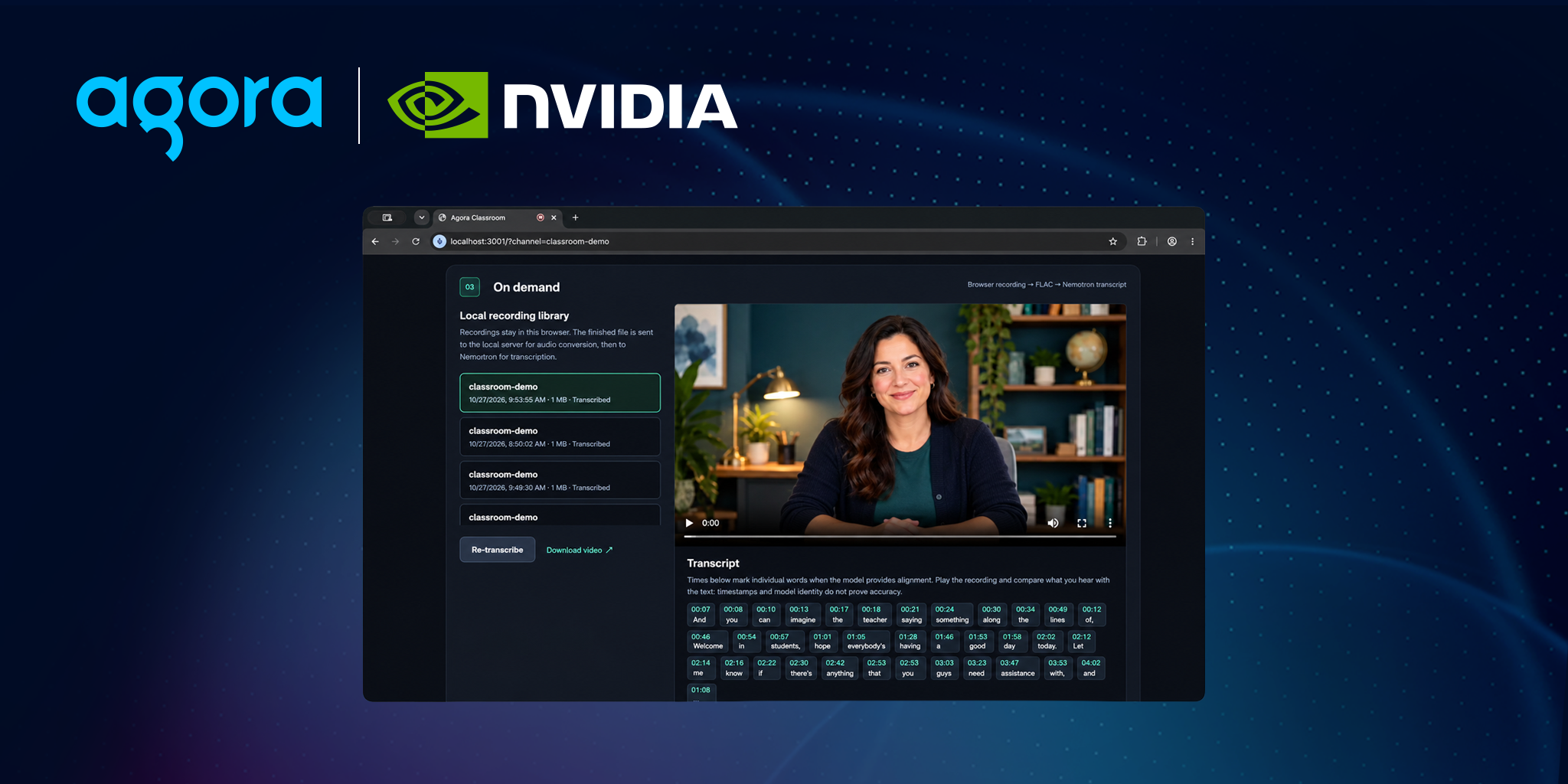
A great class should be useful long after the live stream ends. A student may need to revisit an explanation, catch up on a missed lesson, or find the moment when a teacher answered a particular question. I built a classroom demo to show how a live session can become a recording and a searchable transcript.
In the demo, a teacher broadcasts video and audio, shares content, and teaches a live audience through Agora. The session is recorded in the browser for replay. After class, it sends the audio to NVIDIA’s early-access Nemotron Transcribe model, which returns a transcript with word-level timing. Students can replay the lesson and see what was said and when.
That changes the value of a recording. Instead of scanning through a long video to find one explanation, a learner could search for a term, jump to the relevant moment, and review it at their own pace. A teacher could use the transcript to prepare a recap or identify topics that deserve another lesson. For a student who missed the live session, the replay becomes a practical way back into the class.
Agora provides the live foundation: real-time video and audio, screen sharing, and the option to bring a conversational AI assistant into the experience. An assistant could help answer routine questions during class, giving the teacher more room to focus on teaching. Agora also supports interactive AI avatars, offering another direction for future classroom experiences.
The opportunity extends well beyond a small virtual room. Agora describes education experiences that can scale fromone-to-one instruction to audiences of up to one million students. That makes a classroom reaching hundreds of thousands of learners a compelling product goal. Serving an audience at that size would require an appropriate broadcast architecture and production validation; this demo itself has not been tested at that scale.
The technical flow is straightforward. Agora carries the live class and shared content. The browser creates a playable recording. Once the session ends, the demo submits recorded audio to the early-access NVIDIA Nemotron-3.5-Transcribe-30B-A4B model and displays its word-timed output alongside the session. The separation between live delivery and post-session processing lets each serve a different need: conversation in the moment, then navigation and review afterward.
NVIDIA’s model is exciting here because transcription is more useful when it connects words to moments in the lesson. A transcript with timing can become the basis for searchable replay, precise study references, summaries, and other learning tools. The demo is an early example of what developers can build by combining Agora’s live communication tools with NVIDIA’s speech AI.
For educators, the promise is simple: teach once, then give students more ways to learn from the same session. For developers, the demo shows a path from a working virtual classroom to a richer learning experience that continues after everyone leaves the call.


